Why Choose Tile Roofing in South Florida: The Ultimate Homeowner's Guide
Tile roofing dominates South Florida's residential market for good reason: superior hurricane resistance, 40-50 year lifespan, and 25-30% energy savings…
Tile roofing dominates South Florida's residential market for good reason: superior hurricane resistance, 40-50 year lifespan, and 25-30% energy savings
TL;DR
Tile roofing (concrete and clay) represents the premium roofing choice for South Florida homeowners seeking maximum hurricane protection, energy efficiency, longevity, and property value enhancement, with concrete tile dominating 60-70% of residential installations in Broward and Palm Beach Counties due to lower cost than clay, comparable performance, and extensive Miami-Dade NOA approvals for HVHZ compliance. Concrete tile costs $12-16 per square foot installed vs $18-25 for clay tile, offering similar 40-50 year lifespan, Class A fire rating, Class 3-4 impact resistance for insurance discounts up to 35%, and Miami-Dade NOA approval for 180mph wind ratings meeting HVHZ requirements in hurricane zones. Energy efficiency advantages include 25-30% cooling cost reduction compared to shingle roofs through thermal mass properties where heavy tile absorbs and slowly releases heat, air space between tile and roof deck creating insulation effect, and reflective coatings available on many products boosting solar reflectance to 0.60-0.70 reflecting 60-70% of solar radiation. Hurricane performance is exceptional with proper installation: TAS 100/110/125 testing certification for wind-driven rain and impact resistance, foam adhesive attachment in HVHZ zones providing superior uplift resistance compared to mechanical fasteners alone, and proven track record through Hurricanes Andrew, Irma, and Ian showing 5-10% failure rates for properly installed tile vs 35-45% for shingles. Total cost of ownership over 50 years shows tile roofing is significantly more cost-effective than shingles: initial investment of $28,000-32,000 for typical 2,000 sq ft home lasts 40-50+ years with minimal maintenance ($2,000-3,000 for occasional repairs), while shingles costing $15,000 require complete replacement every 18-20 years resulting in three roof replacements totaling $55,000-65,000 plus $10,000 maintenance costs. Clay tile offers aesthetic premium with authentic terra cotta appearance, lower water absorption (preventing freeze damage though rare in South Florida), slightly longer lifespan (50-75 years vs 40-50 for concrete), and traditional Mediterranean appeal but costs 40-60% more than concrete tile for minimal performance difference in our climate. Installation complexity requires experienced contractors understanding HVHZ fastening requirements with foam adhesive application, proper underlayment (two layers in HVHZ), hip and ridge attachment specifications, and valley construction methods, making contractor selection critical for warranty validity and hurricane performance. Homeowners should expect 5-7 day installation timelines for average homes, structural evaluation to ensure roof can support 7-10 lbs per square foot tile weight (may require rafter reinforcement), building permit requirements with Miami-Dade NOA documentation, and property value increases of 5-10% due to premium roofing investment. Common concerns include tile weight requiring structural support assessment before installation, potential for individual tile breakage from impact or foot traffic (individual tiles easily replaceable unlike shingles requiring large section replacement), higher upfront cost than shingles offset by dramatically lower lifetime costs, and installation timeline slightly longer than shingles due to technical complexity and precision required for proper hurricane resistance.
You're researching roofing options for your South Florida home.
You see tile roofs everywhere: Mediterranean estates, coastal properties, luxury developments.
"Why is tile so popular here?" you wonder.
"Is it worth the higher upfront cost?"
The answer is a resounding yes — and I'll show you exactly why tile roofing dominates South Florida's residential market, how concrete and clay tile compare, what hurricane protection looks like in practice, and why lifetime costs make tile the smartest investment despite higher initial pricing.
Why Tile Roofing Dominates South Florida
Understanding regional roofing preferences.
Market Share Statistics
Residential roofing in Broward and Palm Beach Counties:
- Tile roofing: 60-70% of new installations and replacements
Why such dominance?
✓ Hurricane resistance — Proven performance in Category 4-5 storms ✓ Longevity — 40-50 year lifespan eliminates frequent replacements ✓ Energy efficiency — Significant cooling cost reductions in hot climate ✓ Insurance savings — 15-35% discounts for Class 3-4 impact-resistant tile ✓ Aesthetic appeal — Mediterranean, Spanish Colonial architecture standard ✓ Property value — Premium roofing enhances resale value 5-10%
Historical context:
After Hurricane Andrew (1992), Florida building codes became among the strictest in the nation. Tile roofing with proper HVHZ installation became the gold standard for hurricane protection, driving widespread adoption in coastal counties.
Concrete vs Clay Tile: Market Reality
Concrete tile: 85-90% of tile market
Why concrete dominates: ✓ Lower cost ($12-16 per sq ft installed vs $18-25 for clay) ✓ Comparable performance to clay in South Florida climate ✓ Wide variety of colors and profiles available ✓ Extensive Miami-Dade NOA approvals ✓ Lighter weight than clay (easier installation, less structural load)
Popular concrete tile manufacturers:
Clay tile: 10-15% of tile market (premium segment)
When homeowners choose clay: ✓ Authentic terra cotta aesthetic (traditional Mediterranean) ✓ Slightly longer lifespan (50-75 years vs 40-50 for concrete) ✓ Lower water absorption (minimal freeze concerns, though rare in South Florida) ✓ Premium positioning (luxury homes, historic properties) ✓ Natural material preference
Popular clay tile manufacturers:
Bottom line for most homeowners:
Concrete tile delivers 95% of clay's benefits at 60-70% of the cost — making it the practical choice for South Florida's residential market.
Hurricane Resistance: Tile's Strongest Advantage
Why tile performs exceptionally in high-wind zones.
Miami-Dade NOA Approval Requirements
What HVHZ compliance means:
High Velocity Hurricane Zone (HVHZ) covers Broward and Palm Beach Counties, requiring all roofing products to have Miami-Dade Product Control approval (NOA) demonstrating:
✓ 180mph wind resistance through testing ✓ TAS 100 (wind-driven rain) — Water infiltration resistance ✓ TAS 110 (water resistance) — Secondary water barrier performance ✓ TAS 125 (impact resistance) — Large and small missile impact
Tile roofing advantages in testing:
Weight = stability:
Interlocking design:
Multiple attachment points:
Real-World Hurricane Performance
Hurricane Andrew (1992) — Category 5:
Tile roof performance:
Post-Andrew code changes:
Hurricane Irma (2017) — Category 4:
Modern tile performance (post-code improvements):
Hurricane Ian (2022) — Category 4-5:
Continued tile superiority:
What these statistics mean:
If 100 homes face Category 4 hurricane:
With proper HVHZ tile roofs:
With shingle roofs:
Insurance claim implications:
Average hurricane roof claim: $25,000-40,000
Tile roof avoiding one major claim over 50 years = $30,000+ value
This alone justifies tile's higher upfront cost.
Foam Adhesive Installation in HVHZ
Why foam adhesive is required:
Mechanical fasteners alone (nails/screws):
Foam adhesive:
Application process:
Foam types:
Critical requirement:
Only HVHZ-approved foam products can be used. Using non-approved foam voids Miami-Dade NOA approval and insurance coverage.
!Concrete tile roof installation with proper HVHZ foam adhesive
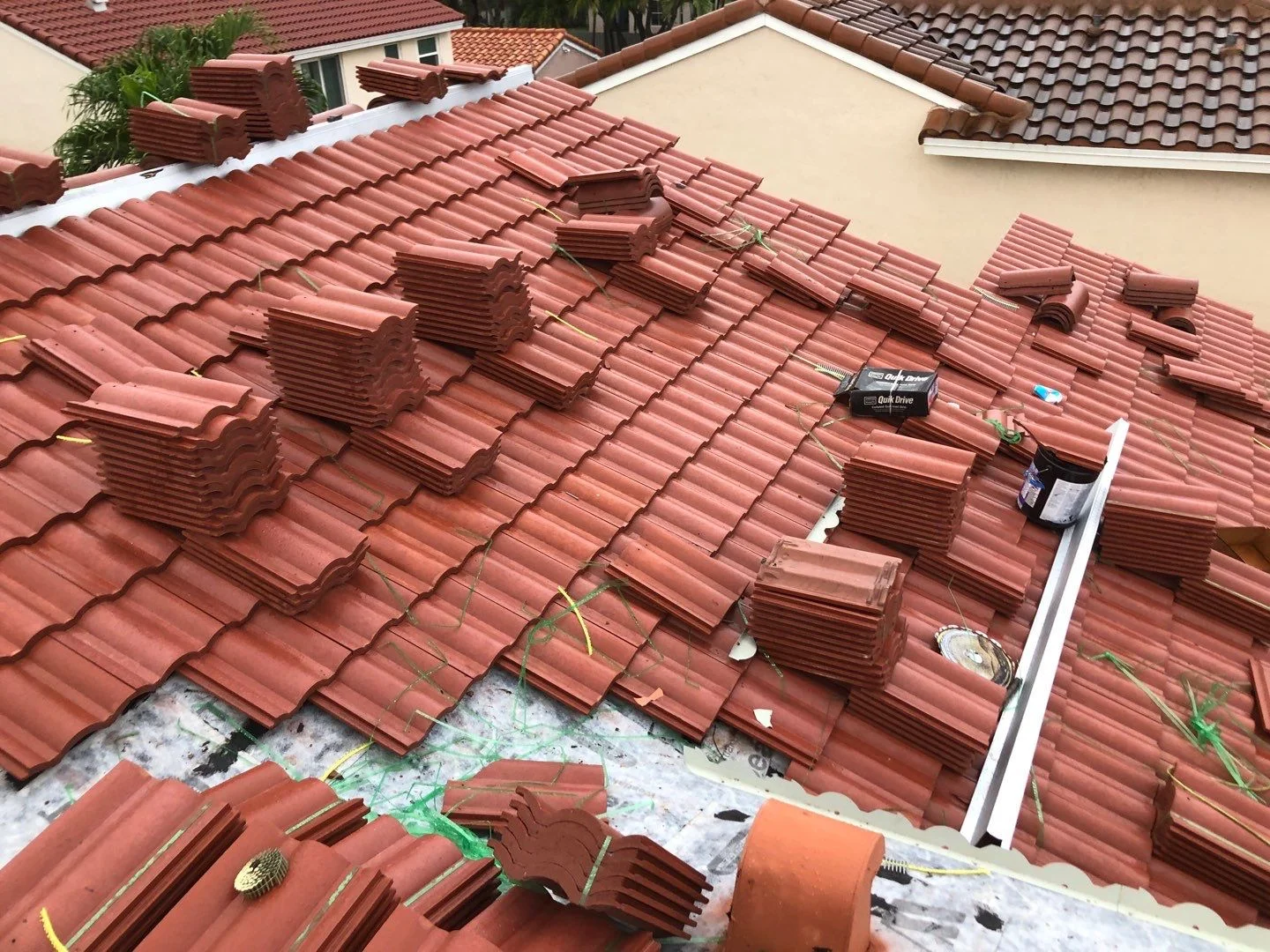
Proper HVHZ installation with foam adhesive ensures maximum hurricane resistance
Energy Efficiency and Cooling Cost Savings
How tile reduces your electric bills.
Thermal Mass Properties
Why heavy materials save energy:
Thermal mass = material's ability to absorb, store, and slowly release heat
Tile roofing (7-10 lbs per sq ft):
Shingle roofing (2-3 lbs per sq ft):
Real-world impact:
Attic temperature at 3pm (95°F outside temperature):
With shingle roof:
With tile roof:
Air Space Insulation Effect
Tile installation creates air gap:
Standard tile installation:
Air space benefits:
✓ Natural convection cooling (hot air rises through ridge vent) ✓ Additional insulation layer (R-2 to R-3 value from air space) ✓ Prevents direct contact between hot tile and roof substrate ✓ Allows moisture to escape (roof deck stays dry)
Combined effect with thermal mass:
Tile + air space = 25-30% cooling cost reduction compared to shingle roofs
Annual savings calculation:
Typical 2,000 sq ft South Florida home:
With shingle roof:
With tile roof:
Over 50 years: $30,000-35,000 in energy savings
Reflective Coatings and Cool Roof Options
Cool tile technology:
Many modern concrete tiles feature cool roof coatings:
✓ Solar reflectance: 0.60-0.70 (reflects 60-70% of solar radiation) ✓ Thermal emittance: 0.75-0.85 (releases absorbed heat efficiently) ✓ ENERGY STAR certification available ✓ Qualifies for FPL Cool Roof rebates (up to $1,700)
Color impact on energy efficiency:
Light colors (white, light gray, terra cotta):
Medium colors (brown, rust, medium gray):
Dark colors (dark brown, charcoal, black):
Strategic color choice:
Most South Florida homeowners choose medium earth tones (terra cotta, mission clay, autumn red) that:
Lifespan and Maintenance Requirements
Long-term performance and costs.
Expected Lifespan
Concrete tile:
Clay tile:
Shingle roofing (for comparison):
Factors affecting tile lifespan:
✓ Installation quality — Proper HVHZ installation = maximum lifespan ✓ Maintenance — Addressing minor issues prevents larger problems ✓ Foot traffic — Minimizing roof access prevents tile breakage ✓ Tree debris — Regular cleaning prevents moss/algae growth
Reality:
Well-installed tile roofs in South Florida routinely last 45-55 years with minimal maintenance.
Maintenance Requirements and Costs
Annual maintenance:
✓ Gutter cleaning (2-3 times per year): $150-300 ✓ Visual inspection (annually): $100-200 or DIY ✓ Debris removal (after storms): $100-200
Periodic repairs (every 10-15 years):
✓ Individual tile replacement (breakage from branches, foot traffic): $200-500 per incident ✓ Valley re-flashing (if showing wear): $800-1,500 ✓ Ridge cap resealing (if mortar deteriorates): $1,000-2,000
Total maintenance over 50 years:
Shingle roof maintenance (for comparison):
Over same 50-year period:
Tile maintenance savings: $35,000-50,000 over 50 years
Individual Tile Replacement Advantage
Unlike shingles, tile damage is localized:
Shingle roof damage:
Tile roof damage:
Example scenario:
Branch falls on roof, breaking 5 tiles:
Repair cost: $200-300 (replace 5 tiles + service call)
Same branch on shingle roof:
Repair cost: $800-1,500 (replace entire damaged section)
Cost Analysis: Initial Investment vs Lifetime Value
Understanding true cost of ownership.
Installation Costs
Typical 2,000 sq ft home (20 squares):
Concrete tile roofing:
Clay tile roofing:
Shingle roofing (for comparison):
Why tile costs more:
✓ Heavier materials (increased shipping and handling) ✓ Longer installation time (precision required) ✓ Specialized labor (HVHZ tile installation expertise) ✓ Enhanced underlayment requirements (two layers) ✓ Foam adhesive materials and application
50-Year Total Cost of Ownership
Concrete tile scenario:
Year 0 (2026): Install tile roof
Years 1-50: Maintenance
Year 50: Tile still functional (may need minor repairs, not replacement)
Total 50-year cost: $40,500
Shingle scenario:
Year 0 (2026): Install shingle roof
Year 18 (2044): Replace shingle roof
Year 36 (2062): Replace shingle roof again
Year 50: Needs replacement soon (deferred)
Maintenance over 50 years:
Total 50-year cost: $63,000-68,000
Tile savings: $23,000-27,000 over 50 years
Insurance Savings
Homeowner's insurance discounts:
Tile roofing benefits:
✓ HVHZ-approved roof: 10-15% discount ✓ Impact-resistant tile (Class 3-4): Additional 15-20% discount ✓ New roof age credit: 10-15% discount ✓ Wind mitigation credits: Maximum tier
Combined insurance savings:
Annual homeowner's insurance: $4,000 (typical South Florida coastal)
With tile roof:
Over 50 years: $70,000 in insurance savings
Note: Insurance savings alone pay for tile roof multiple times over.
Property Value Impact
Real estate market data:
Homes with tile roofs:
Appraisal considerations:
Appraisers assign higher value to:
Example:
$500,000 home with shingle roof:
$500,000 home with tile roof:
Concrete vs Clay Tile: Detailed Comparison
Choosing between the two tile types.
Performance Characteristics
Hurricane resistance:
Lifespan:
Energy efficiency:
Weight:
Water absorption:
Color retention:
Cost:
Aesthetic Considerations
Concrete tile advantages:
✓ Wide range of colors — Dozens of colors available (earth tones to grays) ✓ Multiple profiles — Flat, low profile, medium profile, high profile (barrel) ✓ Modern or traditional — Works with contemporary or Mediterranean architecture ✓ Consistency — Uniform appearance (all tiles identical color)
Clay tile advantages:
✓ Authentic terra cotta appearance — Traditional Mediterranean aesthetic ✓ Natural color variation — Each tile slightly different (artisan character) ✓ Premium positioning — Luxury home standard ✓ Historic authenticity — Matches historic Spanish Colonial architecture
Which to choose:
Choose concrete if:
Choose clay if:
South Florida reality:
85-90% of homeowners choose concrete tile because performance is virtually identical to clay, but cost is 40-60% lower, making it the practical choice for most residential applications.
Installation Complexity and Contractor Selection
Why tile requires specialized expertise.
HVHZ Installation Requirements
Critical installation specifications:
1. Structural evaluation:
2. Underlayment (two layers in HVHZ):
3. Batten installation (for some tile types):
4. Foam adhesive application:
5. Mechanical fastening:
6. Hip and ridge details:
7. Valley construction:
Inexperienced contractors often miss:
✗ Insufficient foam adhesive coverage ✗ Wrong fastener types or lengths ✗ Inadequate underlayment overlap ✗ Improper valley construction (leads to leaks) ✗ Missing structural evaluation (roof can't support tile weight)
Result of poor installation:
Contractor Vetting Questions
Questions to ask tile roofing contractors:
1. Experience and licensing:
2. HVHZ expertise:
3. Warranty and insurance:
4. Installation process:
Red flags:
✗ No specific tile roofing experience ✗ Unlicensed or unwilling to provide license number ✗ No references or portfolio of tile work ✗ Significantly lower price than other quotes (cutting corners) ✗ Pressure to sign immediately without review period
Green flags:
✓ 10+ years tile roofing experience in South Florida ✓ Licensed CCC or CGC contractor ✓ Multiple HVHZ tile installation references ✓ Detailed written proposal explaining HVHZ requirements ✓ Provides Miami-Dade NOA documentation for all products ✓ Discusses structural evaluation and permitting upfront
Addressing Common Concerns
Tile roofing misconceptions and realities.
Weight and Structural Requirements
Concern: "My home was built with shingles. Can it support tile?"
Reality:
Many homes built with shingles CAN support tile roofing with proper evaluation:
✓ Modern construction (post-1992): Most homes designed for tile capacity even if originally roofed with shingles ✓ Rafter sizing: 2x6 or 2x8 rafters at 24" spacing typically adequate for tile ✓ Trusses: Engineered trusses designed for specific load capacity (review original engineering)
When reinforcement is needed:
Reinforcement options:
Cost of reinforcement: $2,000-8,000 depending on extent needed
Solution:
Hire structural engineer ($500-1,000) to evaluate your roof framing before committing to tile. Engineer provides stamped letter confirming adequacy or specifying required reinforcement.
Tile Breakage and Replacement
Concern: "Won't tiles break easily from branches or foot traffic?"
Reality:
Tile is durable but can break under impact or concentrated pressure:
Causes of tile breakage:
Frequency:
Replacement is simple:
Compare to shingle damage:
Shingle damage requires replacing entire section (50-100 sq ft minimum) because:
Tile advantage: Localized, inexpensive repairs vs large section replacements
Upfront Cost Concerns
Concern: "Tile costs $25,000. Shingles cost $15,000. That's $10,000 more I don't have."
Reality check:
Option 1: Finance the difference
Many homeowners finance tile premium through:
$10,000 financed at 6% interest over 10 years:
Option 2: Total cost of ownership perspective
Over 25 years (halfway through tile's lifespan):
Shingle roof:
Tile roof:
Tile saves $7,000 by year 25 despite higher initial cost
Option 3: Insurance claim consideration
If you experience hurricane roof damage with shingles:
Installing tile NOW:
Installation Timeline
Concern: "How long will I be without a roof?"
Reality:
Tile roof installation timeline (2,000 sq ft home):
Day 1: Tear-off and deck inspection
Day 2: Underlayment and preparation
Day 3-4: Tile installation
Day 5: Completion and cleanup
Total: 5-7 days typical (longer for larger or complex homes)
Weather delays possible:
South Florida afternoon storms may delay progress 1-2 days. Experienced contractors monitor weather constantly and pause work when rain threatens.
During installation:
Related Resources
Frequently Asked Questions
How much does tile roofing cost in South Florida compared to shingles?
Concrete tile roofing costs approximately $12-16 per square foot installed ($24,000-32,000 for typical 2,000 sq ft home) compared to shingle roofing at $6-9 per square foot installed ($12,000-18,000 for same home), representing 60-80% higher initial investment for tile, while clay tile costs $18-25 per square foot installed ($36,000-50,000 for typical home) or 100-180% more than shingles. The premium reflects heavier materials requiring specialized shipping and handling, longer installation time due to precision required for proper HVHZ compliance including foam adhesive application and two-layer underlayment systems, specialized labor requiring experienced tile roofing contractors familiar with Miami-Dade NOA installation specifications, enhanced materials including approved foam adhesive, double underlayment layers, and proper flashing, and structural evaluation or reinforcement potentially needed to support tile weight of 8-10 lbs per square foot vs 2-3 lbs for shingles. However, lifetime cost analysis dramatically favors tile roofing: over 50 years, tile costing $25,000 initially lasts entire period with $15,000-20,000 maintenance costs for total of $40,000-45,000, while shingles costing $15,000 initially require complete replacement every 18-20 years resulting in three roof replacements totaling $55,000-65,000 plus $8,000-12,000 maintenance for total of $63,000-77,000, making tile roof $20,000-35,000 cheaper over typical homeownership period. Additional financial benefits include insurance premium discounts of 15-35% annually ($500-1,400/year savings) totaling $25,000-70,000 over 50 years, energy cost savings of 25-30% ($600-700/year) totaling $30,000-35,000 over 50 years, avoided hurricane damage claims preventing $25,000-40,000 in out-of-pocket deductibles and premium increases, and property value increase of 3-5% ($15,000-25,000 on $500,000 home) making tile roofing's total financial benefit $90,000-165,000 greater than shingles despite higher upfront cost.
Is concrete or clay tile better for South Florida homes?
Concrete tile represents the better value for 85-90% of South Florida homeowners due to comparable performance to clay tile at 40-60% lower cost, with concrete costing $12-16 per square foot installed vs clay at $18-25 per square foot, both achieving identical hurricane resistance through Miami-Dade NOA approval for 180mph wind ratings when properly installed with HVHZ-compliant foam adhesive and fastening, and delivering similar energy efficiency benefits through thermal mass properties and air space beneath tiles. Concrete tile advantages include lower cost savings of $8,000-15,000 on typical 2,000 sq ft home, wide color selection with dozens of earth tones and modern colors beyond traditional terra cotta, multiple profile options from flat to high-profile barrel tiles working with contemporary or traditional architecture, lighter weight (8-10 lbs per sq ft vs 9-11 lbs for clay) potentially reducing structural reinforcement requirements, consistent uniform appearance with all tiles identical color, and 40-50 year lifespan exceeding all alternative roofing materials except clay. Clay tile advantages include slightly longer lifespan of 50-75 years (10-25 years more than concrete though both far exceed shingle lifespans of 15-20 years), authentic traditional Mediterranean terra cotta aesthetic with natural color variations giving artisan character, premium positioning appropriate for luxury homes and historic properties, lower water absorption (3-7% vs 10-15% for concrete) providing superior freeze-thaw resistance though South Florida's climate rarely experiences freezing, and marginally better energy efficiency (2-5% improvement) due to clay's lower thermal conductivity. The practical decision comes down to budget and aesthetic priorities: choose concrete tile if cost is significant factor and modern or mixed architectural styles are acceptable, getting 95% of clay's performance at 60% of clay's cost, or choose clay tile if luxury home positioning justifies premium investment, authentic Mediterranean/Spanish Colonial architecture demands traditional terra cotta, budget allows for 40-60% higher material costs, and you prioritize maximum possible lifespan of 50-75 years. For most South Florida residential applications, concrete tile delivers exceptional value combining superior hurricane protection, energy efficiency, longevity, and aesthetics at accessible price point, explaining why concrete tile dominates 85-90% of the tile roofing market in Broward and Palm Beach Counties.
Will my house structure support the weight of tile roofing?
Most modern South Florida homes built after 1992 (post-Hurricane Andrew) can support tile roofing weight without structural modifications because updated building codes required roof framing designed for higher loads even when homes were originally roofed with lightweight shingles, with typical tile weight of 8-10 pounds per square foot supported by standard 2x6 or 2x8 rafters spaced 24 inches on center or engineered trusses rated for appropriate loads. However, structural evaluation by licensed engineer is essential before committing to tile roof installation to verify existing roof framing adequacy, identify any necessary reinforcement, prevent costly mid-project discoveries, and provide documentation for building permit application. Homes requiring structural reinforcement typically include older properties built before 1970s with undersized 2x4 rafters originally designed only for lightweight shingle loads, roofs with rafters spaced wider than 24 inches on center reducing load-bearing capacity, homes showing visible sagging or deflection in existing roof indicating overstressed framing, and properties with long unsupported rafter spans exceeding 18 feet without intermediate support beams. Reinforcement solutions include sistering additional rafters alongside existing rafters to double load capacity at cost of $2,000-5,000 for typical home, adding intermediate support through ridge beams or collar ties at $3,000-6,000, or upgrading to engineered trusses in extreme cases at $8,000-15,000 (rare, usually not economically justified). The evaluation and reinforcement process involves hiring structural engineer for $500-1,000 to inspect roof framing and provide stamped letter confirming adequacy or specifying required modifications, contractor implementing engineer-specified reinforcement before tile installation, building department reviewing engineer plans during permit application, and inspector verifying reinforcement completed per approved plans before tile installation proceeds. Cost-benefit consideration: spending $500-1,000 on engineering evaluation plus $2,000-8,000 on reinforcement if needed is worthwhile investment protecting $25,000-35,000 tile roof installation and ensuring safety and code compliance, while discovering structural inadequacy mid-project without prior evaluation creates expensive delays, change orders, and potential permit failures making upfront engineering assessment always advisable for tile roofing projects especially on homes built before 2000.
How long does tile roofing last in South Florida's climate?
Concrete tile roofing lasts 40-50 years in South Florida with proper installation and minimal maintenance, while clay tile lasts 50-75 years, both significantly exceeding shingle roofing lifespan of 15-20 years in South Florida's intense heat, humidity, and UV exposure that accelerates roofing material degradation. Factors maximizing tile lifespan include proper HVHZ-compliant installation with Miami-Dade approved foam adhesive and two-layer underlayment creating robust attachment resisting hurricane winds and water infiltration for decades, quality materials from reputable manufacturers like Eagle, Boral, or Hanson for concrete tile or Ludowici for clay tile all offering 30-50 year warranties, regular maintenance including annual inspections identifying minor issues before they escalate, prompt repairs of individual broken tiles from storm debris preventing water infiltration, minimal foot traffic avoiding unnecessary tile breakage (only walk on roof when absolutely necessary for maintenance), and periodic cleaning removing organic growth (moss, algae, lichen) that can deteriorate tile surfaces over time. South Florida's climate poses specific challenges including intense UV radiation degrading lower-quality concrete tiles over decades (premium tiles with UV inhibitors resist fading better), high humidity and heavy rainfall testing underlayment and flashing waterproofing (proper initial installation prevents leaks), salt air in coastal zones potentially affecting fasteners and underlayment (stainless steel fasteners recommended within 5 miles of coast), and hurricane exposure every few years stressing tile attachment systems (HVHZ installation with foam adhesive provides superior resistance). Real-world performance data shows well-installed tile roofs in South Florida regularly achieve or exceed manufacturer-specified lifespans with 40-45 year-old concrete tile roofs remaining functional with only minor repairs, 60-75 year-old clay tile roofs on historic properties still performing well, and properly maintained tile roofs requiring individual tile replacement (5-20 tiles over lifetime) rather than complete roof replacement unlike shingles needing full replacement every 18-20 years. Economic analysis over 50 years demonstrates tile's lifespan advantage creates dramatic cost savings: one tile roof installation at $25,000 lasting 45-50 years with $15,000 maintenance costs $40,000 total, while three shingle roof replacements at $15,000, $18,000, and $22,000 plus $10,000 maintenance total $65,000, making tile's longevity deliver $25,000 savings over typical homeownership period while providing superior hurricane protection and energy efficiency throughout entire lifespan.
Does tile roofing qualify for insurance discounts in Florida?
Yes, tile roofing qualifies for substantial homeowner's insurance discounts in Florida through multiple rating factors including impact resistance ratings where Class 3 or Class 4 impact-resistant tile provides 15-25% premium discounts, HVHZ-approved roofing in Broward and Palm Beach Counties offering 10-15% discounts for products with Miami-Dade NOA certification meeting 180mph wind requirements, new roof age credits providing 10-20% discounts for roofs less than 10 years old with diminishing discounts as roof ages, and wind mitigation inspection credits rewarding proper installation features like foam adhesive attachment, secondary water barriers, and proper hip/ridge fastening. Combined insurance savings for new HVHZ-approved impact-resistant tile roof total 25-40% reduction in annual premiums, translating to $1,000-1,600 annual savings on typical South Florida homeowner's policy costing $4,000 baseline or $50,000-80,000 in insurance savings over 50-year tile roof lifespan. The savings calculation varies by property value, location (coastal properties pay higher base premiums), insurance carrier (companies weight factors differently), policy details (coverage limits, deductibles), and wind mitigation features beyond roofing (impact windows, reinforced doors, roof-to-wall connections), with typical scenarios showing $400,000 home in Broward County with tile roof saving $1,200-1,400 annually, $600,000 coastal home in Palm Beach County saving $1,400-1,800 annually, and $800,000+ luxury home potentially saving $2,000-2,500 annually on insurance premiums. To maximize insurance discounts, homeowners should ensure contractor provides documentation of Miami-Dade NOA approval for all roofing products installed, obtain wind mitigation inspection after installation documenting proper HVHZ features ($75-150 cost for inspection), submit wind mitigation report to insurance carrier requesting all applicable discounts, verify insurance carrier applies all eligible rating credits (roof age, impact resistance, HVHZ approval, wind mitigation features), and shop insurance carriers annually as companies vary significantly in how they value tile roofing (some carriers offer larger discounts than others for identical roof), potentially finding $500-1,000+ additional savings through carrier comparison. The insurance benefit alone substantially offsets tile roofing's higher upfront cost: $1,300 annual savings × 30 years = $39,000 in insurance savings, nearly paying for entire $25,000-30,000 tile roof installation while providing superior hurricane protection that prevents costly claims, reduced claim frequency improving future insurance rates, and peace of mind during hurricane season knowing your roof meets highest protection standards available for residential construction.
Final Thoughts
Tile roofing represents the premium choice for South Florida homeowners who prioritize:
✓ Maximum hurricane protection — Proven 95%+ survival rate in Category 4-5 storms ✓ Lifetime value — $25,000-35,000 savings over shingles despite higher initial cost ✓ Energy efficiency — $30,000-35,000 in cooling cost savings over 50 years ✓ Insurance savings — $50,000-80,000 in premium reductions over roof lifespan ✓ Property value — Premium positioning and enhanced resale value ✓ Peace of mind — 40-50 years without roof replacement concerns
For most homeowners, concrete tile delivers the best balance:
The upfront cost premium ($10,000-15,000 more than shingles) pays for itself multiple times through:
Tile roofing isn't just a roof — it's a 50-year investment in your home's protection and value.
📍 All Phase Construction USA
590 Goolsby Blvd, Deerfield Beach, FL 33442
📞 Call: 754-227-5605
✉️ Email: info@allphaseusa.com
Licensed CCC & CGC Contractor | Tile Roofing Specialists | HVHZ Experts
CGC-1526236 | CCC-1331464
Need Professional Roofing Service?
Contact All Phase Construction USA for expert roofing services in Broward and Palm Beach County.
Call (754) 227-5605Related Services & Resources
Roof Repair · Free Inspections · Cost Calculator · All Articles