The Quiet Hurricane Season Didn't Save Your Roof
The quietest hurricane season in a century did not spare South Florida roofs. Three October jobs show what heat, salt air and trapped humidity did unseen.
No storm hit South Florida this year. The sun, the salt and the attic did not take the season off, and three roofs we opened up this month prove it.
2026 has been a strange Atlantic hurricane season. A record-strength El Niño pushed wind shear and dry, sinking air across the basin all summer, and the first hurricane of the year did not form until October 7, the latest in more than a century. When Isaias finally arrived it went to the Panhandle, not here. The season runs through November 30, and barring a late surprise, Broward and Palm Beach County will close it out without a storm.
Which is wonderful. It is also about to lead a lot of homeowners to the wrong conclusion: nothing hit my roof, so my roof is fine.
A storm is not what ages a roof in South Florida. A storm is the event that forces you to go look at it. What does the actual work is heat, ultraviolet light, salt-loaded air and water sitting against metal, and all four ran at full strength for six months whether a hurricane showed up or not. A quiet season removed the one thing that would have made you check. Nothing else about your roof changed.
We know this because of what we found this month.
Lighthouse Point: the roof that looked fine from the driveway
This tile roof looked exactly the way a tile roof is supposed to look. No slipped tiles, no stains, nothing a homeowner could have pointed to from the yard. The owners were replacing it on age and on a planned schedule, not because anything had announced itself.
Then the tile came off.
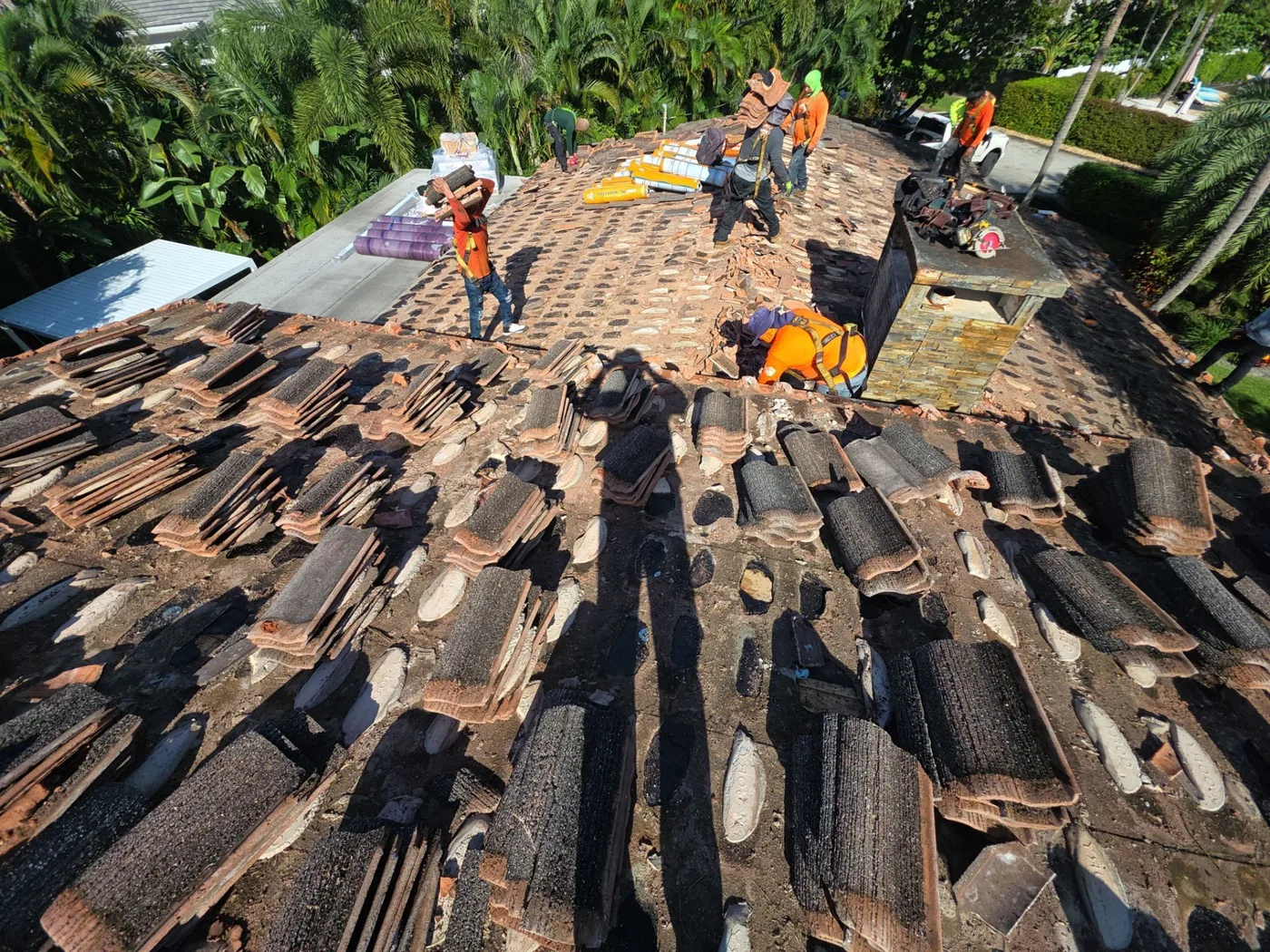
The tile coming off around the chimney in Lighthouse Point. The rusted-through flashing underneath never showed from the driveway.
The chimney flashing was rusted through, and the corrosion had spread across the pan below it where water had been pooling against the metal, out of sight, for a long time. No storm caused it. No wind lifted anything. This house sits minutes from open salt water, and that is the whole story: salt air goes after metal before it goes after anything else, and it does that every day of the year.
If you take one thing from this article, take that scene: the flashing was invisible until the tile was gone. The only reason it was caught before it became a ceiling repair is that the owners chose to replace the tile roof before it forced them to. That is what a planned roof replacement in Lighthouse Point looks like when it goes right.
Boca Raton: the enemy that was inside the house
The second job was a set of shingle repairs in Boca Raton, and the fix included cutting a new opening in the roof deck and adding a solar-powered attic exhaust fan.
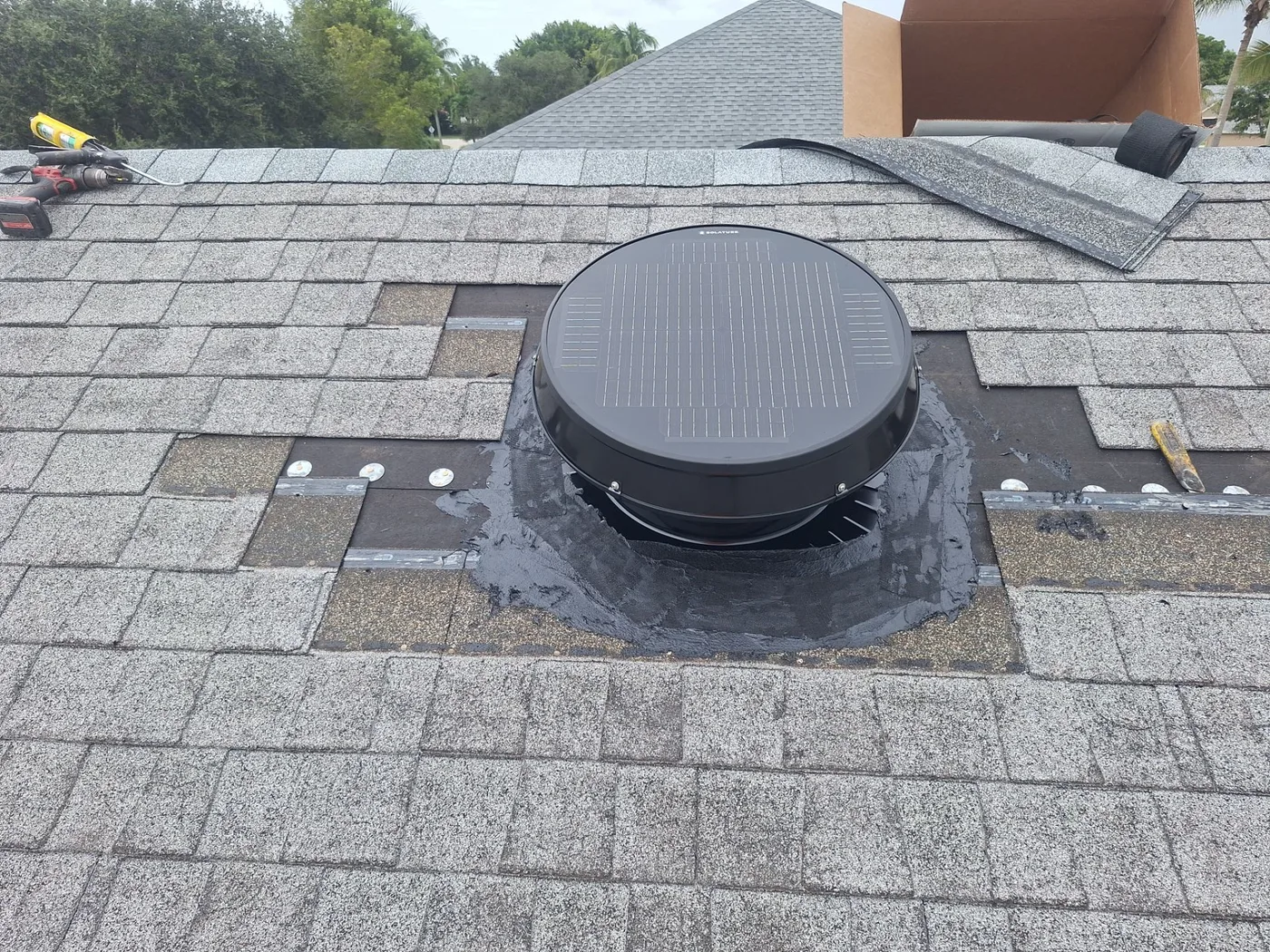
A new exhaust opening with a solar attic fan, cut in during shingle repairs in Boca Raton. The ventilation mattered as much as the repair.
Why does a shingle repair come with a fan? Because on this roof the damage was being done from underneath. An attic with no real exhaust path in South Florida becomes an oven. Heat and humidity get trapped under the deck and cook the plywood and the back of the shingles from the inside, hour after hour, on every clear day. Repairing the shingles without fixing the airflow would have been a bandage on a roof that was still being slow-roasted.
That process does not need a storm. It ran every day of the quietest season in a century, and it is running right now in attics nobody has opened since spring. If you are a seasonal resident returning to a house that sat closed all summer, this is the roof problem you are most likely to have. The shingle repair is often the smaller half of the job.
Coral Springs: what acting early looks like
The third job is the short one. A home in Coral Springs has a tile roof with a flat section, both at the end of their useful life, and the owners are replacing the whole system before anything fails: standing seam metal going onto the pitched areas and a fully adhered PVC membrane on the flat.
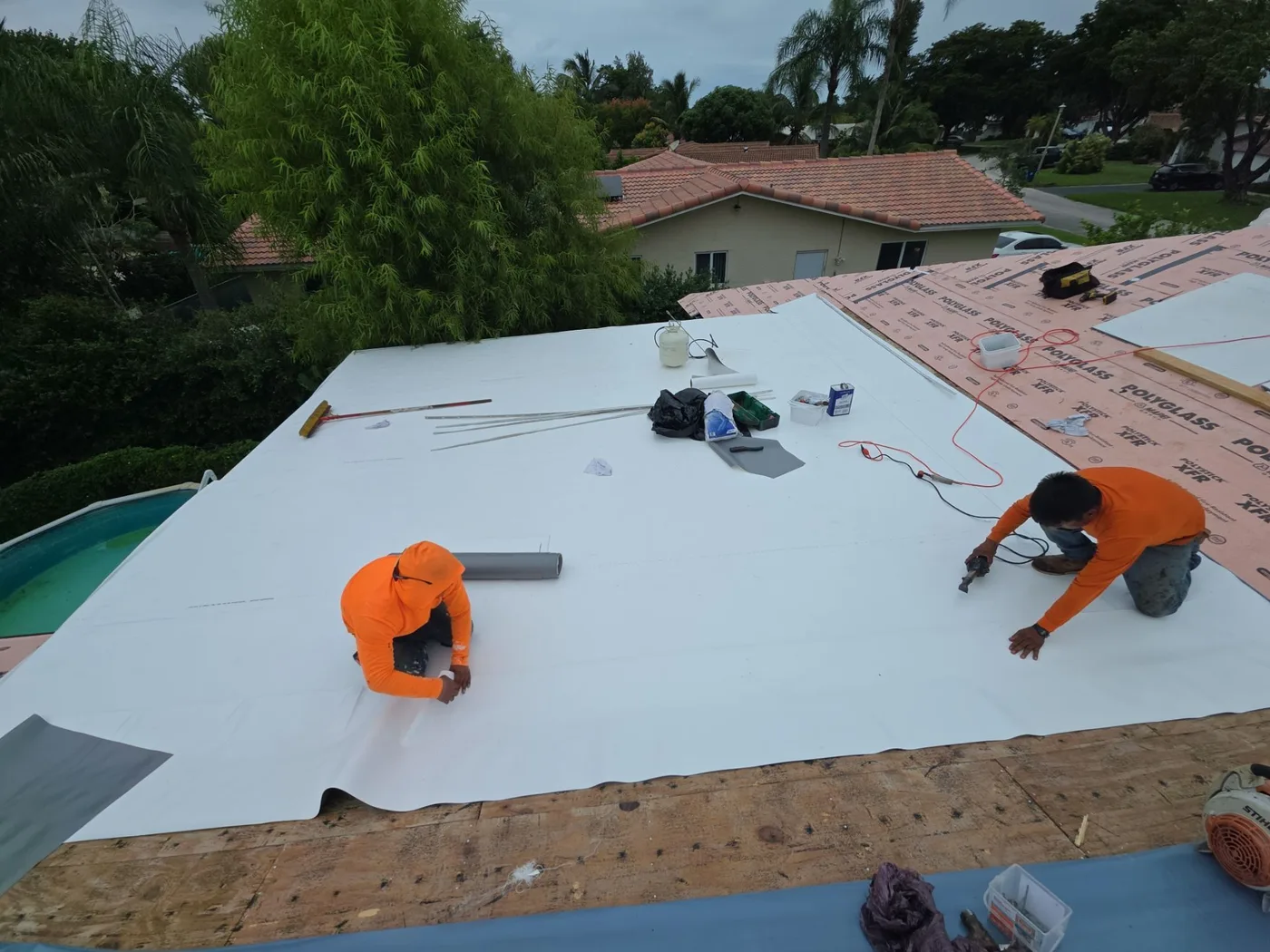
The PVC flat section going down in Coral Springs, pitched slopes dried in behind it — a replacement scheduled on the homeowner's calendar rather than a leak's.
No tarps, no emergency call, no scrambling for a crew in the one week every roofer in the county is booked. The difference between this job and an emergency replacement is not the roof. It is who chose the timing.
Repair, restore or replace: why nobody can tell you from the phone
Something we have noticed in our own office, and it is worth being honest about: when a call comes in, the person taking it writes down what the homeowner thinks they need, and very often that is "repair," "seal it" or "restore." A meaningful share of the time, once someone is on the roof, the job turns out to be a full replacement. That is not the homeowner being naive. Our own trained staff cannot reliably name the job from a phone call either. The roof decides, and it only tells you up close.
So it helps to know what the three words mean, because they are not three sizes of the same thing.
A repair fixes a specific, local problem on a roof that is otherwise sound: a cracked tile, a failed pipe boot, a run of flashing, a few lifted shingles. The surrounding roof has life left, so you fix the spot and leave the rest alone.
A restore (a coating or a recover) treats the surface of a roof that is tired but structurally intact. On a flat roof that means cleaning, repairing seams and applying a new waterproof coating over the existing membrane; on tile it can mean lifting and resetting the tile over new underlayment. It buys time at a fraction of replacement cost, but only if what is underneath is still sound. A coating over a saturated deck or a rusted pan is money on top of a problem.
A replacement takes the roof covering down to the deck and starts over: new underlayment, new flashing, new covering, and new wood wherever the old wood is bad. It is the right answer when the underlying components have failed, when the roof has reached the end of its life, or when the cost of repairs is approaching the cost of doing it right.
The hard part is that what separates "restore" from "replace" is almost always hidden: the condition of the deck, the underlayment and the metal, none of which you can see from the ground and little of which you can see from the roof surface. From above, through the tile, the Lighthouse Point roof was a restore candidate. With the tile off, it was not. The honest answer to "what does my roof need" usually requires someone standing on it, and sometimes requires opening it up.
What you can actually check yourself
You do not need to get on your roof, and in most cases you should not. But two places tell you most of what a homeowner can learn without a ladder.
From the ground, walk the perimeter after a hard rain. Look for slipped or cracked tiles, curled or lifted shingle edges, dark streaks below valleys or around the chimney, and rust at the edges of flashing or vents. Check the gutters for shingle granules, and the fascia and soffit for staining or peeling paint, which is often water finding its way out from somewhere above.
From the attic, which is the honest answer for most people, take a flashlight up on a sunny afternoon. Three things matter. Staining on the underside of the roof deck: dark rings, water tracks, discolored plywood. Daylight: turn the flashlight off and look up, because anywhere you can see light, water can come in. And the air itself: if the attic is blistering hot with no airflow, you have found the Boca Raton problem, and it is working on your roof from the inside whether or not anything has leaked yet.
Where self-inspection stops is the surface and what is under it. You cannot judge underlayment, flashing, deck soundness or the metal under a tile roof from the attic or the yard. That takes someone on the roof who knows what they are looking at, and it should not cost you anything to find out. We inspect roofs across Broward and Palm Beach County at no charge and no obligation, and we will tell you if the answer is "leave it alone for another year," because sometimes it is.
The hurricane that never came did not save your roof. It gave you a quiet season to go look at it. Use it.
All Phase Construction USA, LLC is a dual-licensed roofing and general contractor (CCC-1331464 / CGC-1526236) headquartered at 590 Goolsby Blvd, Deerfield Beach, FL 33442, serving Broward and Palm Beach County since 2006. A live person answers every call, and we guarantee scheduling within 24 hours. Call (754) 227-5605 or request a free inspection.
Need Professional Roofing Service?
Contact All Phase Construction USA for expert roofing services in Broward and Palm Beach County.
Call (754) 227-5605Related Services & Resources
Roof Repair · Free Inspections · Cost Calculator · All Articles